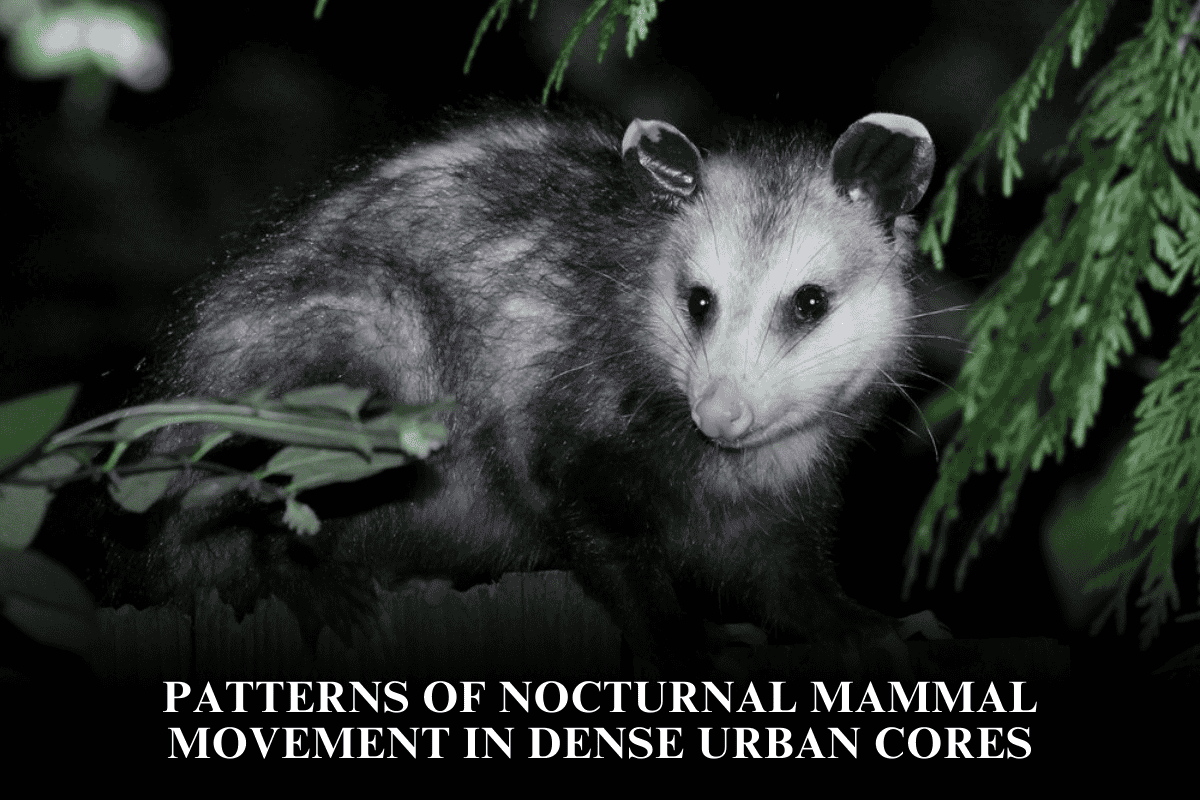
Nocturnal mammals adapt their movement patterns in dense urban cores to balance risks and resources, often becoming more active at night to avoid human interaction, traffic, and disturbance. This temporal shift in activity allows mammals like raccoons, coyotes, foxes, opossums, and skunks to persist and even thrive within heavily populated city centers.
Key Findings on Nocturnal Mammal Movement
- Most urban mammal species show increased nocturnality, with peak activity during the darkest parts of the night to minimize human encounters, although species-specific and site-specific variations occur.
- Larger mammals such as black bears and white-tailed deer also exhibit shifts towards more nocturnal activity in urbanized areas to reduce daytime risks from humans and vehicles, demonstrating behavioral plasticity across taxa.
- Some species, like red foxes, have adapted by becoming more diurnal in urban settings, potentially using human presence as a “shield” from more dominant nocturnal predators like coyotes.
- Urban environmental factors influencing these patterns include human population density, artificial light at night, noise pollution, impervious land cover, and availability of green spaces or urban trees that provide refuge and corridors for movement.
- Artificial lighting tends to suppress movement in some nocturnal species due to disruption of natural circadian rhythms, while others adjust timing to avoid brightly lit areas.
- Wildlife in dense urban cores face trade-offs between avoiding humans, risks of traffic collisions, and predation pressures; hence, their temporal activity patterns yield critical insights into their urban adaptation strategies.
Ecological and Conservation Implications
Understanding these movement patterns is vital for urban planning that accommodates wildlife corridors, reduces road mortality, and manages urban lighting to support biodiversity. Adaptive temporal niches used by urban mammals reflect their resilience but also underline the challenges they encounter in human-dominated landscapes.
FAQ: Nocturnal Mammal Movement in Urban Cores
Q: Why do urban mammals become more nocturnal?
A: To avoid direct human contact, noise, and traffic during the day, reducing risk and disturbance.
Q: Do all mammals become nocturnal in cities?
A: No, some species, like red foxes, increase daytime activity, likely to avoid dominant nocturnal predators.
Q: How does artificial light affect nocturnal wildlife?
A: Light pollution can suppress activity or shift movement to darker areas, impacting natural behavior and fitness.
Q: What urban features encourage nocturnal mammal movement?
A: Green spaces, urban trees, and connected habitats provide shelter and pathways for safe nocturnal movement.
Q: How can cities support urban nocturnal mammals?
A: Implement wildlife-friendly lighting, preserve green corridors, and design road-crossing structures to minimize vehicle collisions.